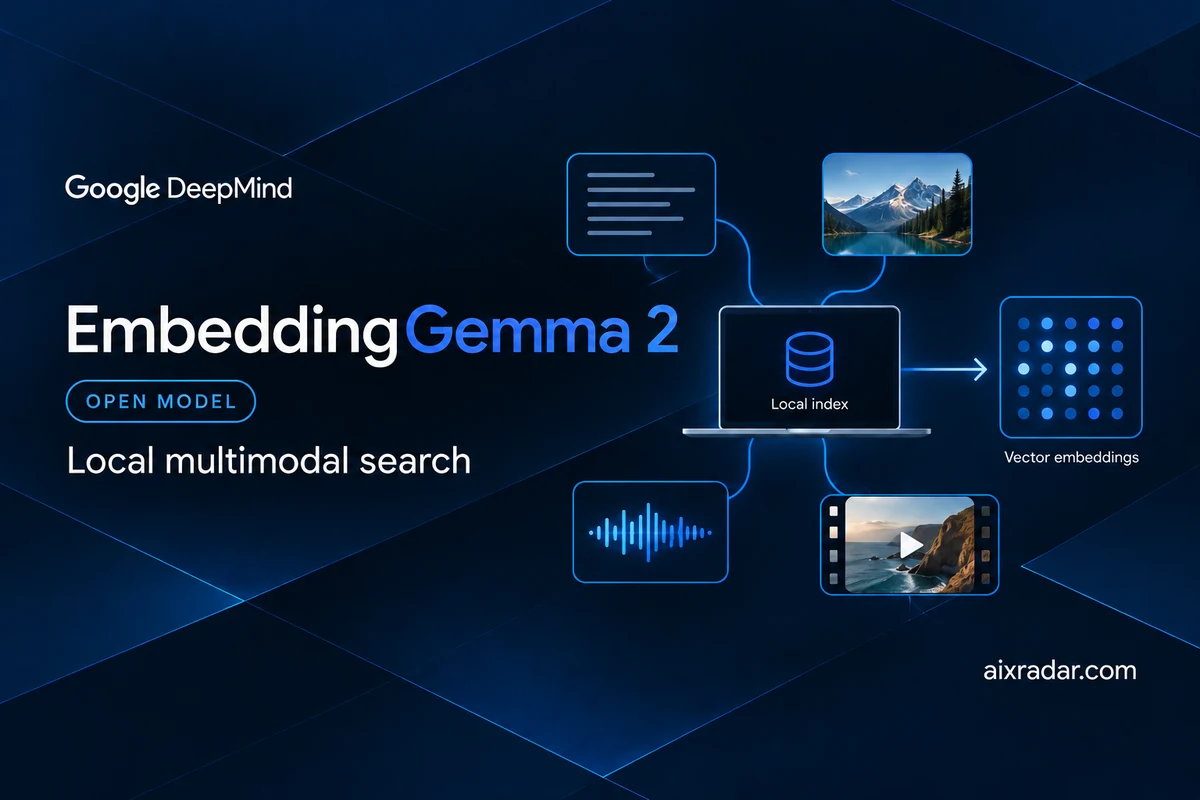

Google released EmbeddingGemma 2 on 6 October 2026 as an open multimodal embedding model for local search and retrieval. It maps different kinds of input into comparable numerical representations, giving developers a way to search across text, images, audio and video. It is not a chatbot model that writes an answer or creates an image. Google’s announcement establishes the release and its on-device focus.
For developers building AI software, the useful question is whether local retrieval can find the right evidence with acceptable speed and resource use. This report explains the model’s modular design, what is available now, and the checks needed before moving an existing search index.
News reporting cutoff: 7 October 2026, 18:02 Asia/Karachi (13:02 UTC). Primary documentation checked on 7 October. No AIX Radar device benchmark or retrieval test is claimed.
What changed: one embedding space across media
An embedding represents an input as a vector: a list of numbers that a search system can compare with other vectors. EmbeddingGemma 2 brings multiple media types into a shared space. That makes cross-media retrieval possible, such as using a text query to find relevant material in an image collection. Google makes performance claims for the model, but those claims do not establish the retrieval quality of a particular site’s content.
Search still needs the surrounding application. A model produces representations; the index stores them, access controls decide which results a user may see, and a ranking or generation layer can present the results. Getting the representation right is valuable, but it does not remove those other responsibilities.
Choose the modules your application actually needs
The developer guide describes a modular model: a 270-million-parameter text component, a 170-million vision component and a 300-million audio component. Developers can load the relevant combination rather than always loading the complete 740-million-parameter system.
| Configuration | Documented parameter count | Example workload to evaluate |
|---|---|---|
| Text and code | 270 million | Search a documentation library |
| Text plus vision | 440 million | Find images using a written query |
| Text plus audio | 570 million | Retrieve relevant audio material |
| Full multimodal configuration | 740 million | Search a mixed-media collection |
A text-only knowledge base has little reason to carry unused media components into its first pilot. A mixed-media product has a different requirement: evaluate the queries that move between media, rather than judging the model only on ordinary text search. Keep a record of the module configuration so results remain interpretable.
Vectors, context and licensing
The official model card lists a 768-dimensional shared embedding space, an 8,192-token context limit and an Apache 2.0 license. It also describes reduced vector sizes of 128, 256 and 512 dimensions. Downloadable files are listed in Google’s Hugging Face repository; a local deployment route is available rather than only promised.
Smaller vectors create a concrete storage trade-off. As a hypothetical raw-storage calculation, one million 768-dimensional vectors stored as 32-bit values require 3.072 billion bytes. Using 256 dimensions requires 1.024 billion bytes for the vector values alone, a two-thirds reduction. That excludes identifiers, metadata, index overhead, replicas and backups. It also says nothing about whether the shorter vectors find equally useful results.
Measure retrieval quality before selecting the smaller representation. A cheaper index that misses the essential evidence can increase downstream model costs and manual searching. Licensing is also only one part of deployment: review dependencies, input rights and your organization’s requirements before distributing an application.
Local processing helps, but privacy depends on the whole system
Running an embedding model locally can reduce the need to send source material to an external embedding service. It does not automatically make every part of a retrieval application local or private. Logs, cloud storage, analytics, backups and a remote answer-generation model can still move information outside the device.
Trace the complete path of a document and query. Record where the original file lives, where vectors and snippets are stored, and which components receive the retrieved material. If the product promises offline search, verify that behavior with the network unavailable instead of inferring it from the model’s ability to run on a laptop.
Access permissions deserve a separate test. Similarity search should not reveal a restricted document’s title or excerpt to an unauthorized user. Apply authorization when retrieving evidence and when preparing any answer, not merely when opening the final document.
How to evaluate a search migration without replacing the live index
- Build a reference query set. Include common questions, rare terms, code identifiers, relevant languages and deliberately difficult examples. Have a reviewer identify acceptable source items.
- Create a separate candidate index. Keep the current search system intact. Record chunking, prefixes, module configuration and vector dimensions so changes can be traced.
- Inspect retrieval before generation. Check whether useful evidence appears in the first several results. A fluent generated answer can conceal missing or irrelevant retrieval.
- Test each needed modality. For an image collection, include similar-looking items with different meanings. For audio or video, check that the retrieved segment actually contains the requested information.
- Measure resources on the target device. Record indexing time, query latency, peak memory, storage and battery impact where relevant. Vendor device figures are not a guarantee for different hardware.
- Review failures and permissions. Include deleted files, changed access rights and an unauthorized account. Verify that stale vectors and excerpts do not continue exposing removed information.
This is an evaluation plan, not a sequence AIX Radar has already executed. Keep a held-out query set for the final comparison and report the sample size with any measured quality result.
What is ready, and what is still coming?
Google’s AI Edge release notes describe available demonstration applications and experimental local workflows. They also say ML Kit Android support is coming in the following weeks. Treat that forthcoming integration separately from the downloadable model; do not plan a production launch around an undated promise.
EmbeddingGemma 2 gives local AI applications a concrete new retrieval component. Start with a small, representative corpus and a parallel index. The decision to adopt it should follow useful retrieved evidence, privacy checks and resource measurements on the hardware your users will actually have.