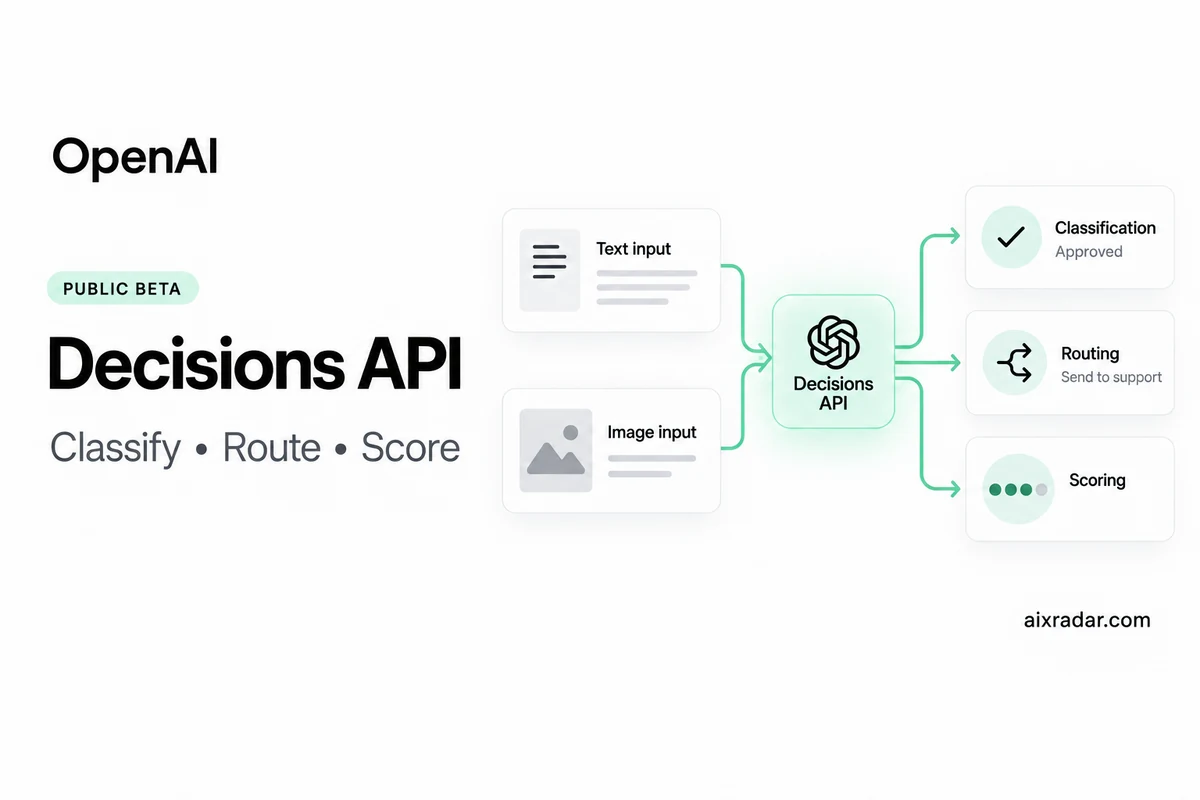

OpenAI’s Decisions API entered public beta on 6 October 2026, with GPT-6 Luna as its supported model. It gives applications a dedicated way to classify text or images, select an option and score an input, instead of asking for a conversational answer and then parsing it. The official API changelog establishes the beta release date.
This is an availability update to technology introduced around DevDay, not a new announcement of the underlying idea. For SaaS teams, the practical opportunity is a narrower evaluation: can a typed decision improve a routing or triage step without sacrificing accuracy, reviewability or control?
News reporting cutoff: 7 October 2026, 18:02 Asia/Karachi (13:02 UTC). Official documentation checked on 7 October. AIX Radar has not run paid API tests or measured the advertised speed.
What the Decisions API returns
The official guide describes three answer types: a predicate estimates whether a condition holds, a choice selects from supplied options, and a score evaluates ordered levels. The endpoint is POST /v1/decisions. OpenAI describes it as roughly ten times faster than the Responses API; that is a provider claim, not a measured improvement in every application.
| Decision type | Possible application | Question to settle before using it |
|---|---|---|
| Predicate | Flag an image for manual inspection | Which mistakes are costliest to miss? |
| Choice | Send a support request to a queue | Is there a route for ambiguous cases? |
| Score | Prioritize an issue for review | Do the ordered levels have distinct meanings? |
Those examples are workflow ideas, not results from a test. A machine-readable answer reduces parsing work, but its type does not prove its correctness. An application still needs rules for uncertainty, refusals and cases outside its categories.
Pricing is specific to the Decisions endpoint
The Decisions guide lists $0.10 per million input tokens with GPT-6 Luna and no output, cache-read or cache-write charges for this endpoint. Regional processing premiums and long-context multipliers can apply. Other uses of the same model follow the applicable model and processing-tier pricing; do not apply the Decisions rate to an ordinary generation request.
For a hypothetical workload of 50,000 requests averaging 800 billed input tokens each, the input total would be 40 million tokens. At the stated base rate, the endpoint charge would be $4. That calculation assumes the base pricing applies and excludes retries, any other services and application infrastructure. It is a planning example, not a usage invoice or promised monthly bill.
The inexpensive individual decision can still feed an expensive process. If a classifier sends too many cases to a larger model or a human queue, the downstream cost may dominate. Track the entire route: the initial decision, follow-up calls, corrections and staff time. Compare cost per correctly handled case, not only cost per API call.
Check input restrictions before porting a workflow
The endpoint reference permits text and inline images, with up to 128 images per request. Images require data URLs; external image URLs and file IDs are not supported. The reference also excludes audio, function calls and item references from the supported input format. An answer can be a refusal rather than a scored result.
That changes a common migration assumption. An application currently handing another endpoint an image URL cannot necessarily reuse its request unchanged. Design the conversion and validation step explicitly, check image sizes and timeouts, and make failure handling visible. Do not let a missing or unreadable image silently become a negative classification.
The API should also receive only the evidence the task requires. A support-routing task rarely needs the complete customer history. Keeping the input focused makes category definitions easier to inspect and reduces the chance that irrelevant material influences the decision. Review the provider’s current data controls before sending confidential inputs; a beta announcement is not a substitute for that review.
A useful first pilot: support-ticket routing
Consider a SaaS business with separate account-access, billing and technical queues. Begin with already resolved tickets whose destinations a reviewer has checked. Remove information the routing step does not need, and write category descriptions that distinguish the team’s actual responsibilities. A ticket about a failed paid upgrade may reasonably concern both billing and technical support; that ambiguity should be represented in the handling rule.
Run the candidate system in observation mode first. Record its proposed queue without allowing it to move the live ticket. Compare the proposal with the reference decision and inspect disagreements. Separate genuinely incorrect classifications from cases where the team’s original categories overlap. Otherwise, changing the prompt can conceal a process problem.
Report the sample composition as well as the overall result. A pilot dominated by straightforward billing requests can look accurate while handling account-access problems poorly. Include short messages, long threads, missing context and the languages customers actually use. Keep a held-out sample for the final check, and have a person review uncertain cases.
Set decision thresholds around the consequence
A probability should not be treated as a universal guarantee. Choose a threshold using labelled examples and the cost of each error. Sending a ticket to the wrong internal queue may be recoverable; automatically refusing service or taking a security action can have a much larger consequence. The same threshold need not be suitable for both.
Keep a fallback route and record why it was used. Review refusals, low-confidence answers, unfamiliar categories and invalid input separately. Monitor changes over time: a product launch, new language or altered support policy can shift the input distribution even if the model remains unchanged.
Measure end-to-end latency, including image preparation, network time and fallback processing. OpenAI’s speed comparison does not establish the improvement a user will see inside your own system.
Where the beta fits in an existing AI application
The Decisions API is worth evaluating where a narrow, typed answer directly supports a defined workflow. An application needing an explanation, custom extracted fields or tool orchestration still needs a suitable generation or orchestration path; a decision result is only one component of the system.
Keep the existing route available during the pilot, define a spending limit and record the documentation version you used. The meaningful release here is access to a specialized beta endpoint. The business case still depends on whether it improves correct handling of your real inputs, with manageable downstream costs.