
I ran both StealthGPT and WriteHuman through GPTZero last week. Neither passed. Both returned 100% AI — despite their marketing pages claiming near-perfect rates to bypass AI detection. So here’s the real story of two AI humanizer tools that promise human-like output but don’t quite deliver.
Quick Verdict — StealthGPT vs WriteHuman at a Glance (2026)
Before the details — here’s the short version. Neither AI humanizer consistently produces undetectable text that fools strict detectors. StealthGPT offers more features (Chrome extension, SEO-optimized writer, stealth mode). WriteHuman keeps things simpler with tone adjustment and a cleaner interface. Both need manual editing afterward to bypass AI detection on stricter platforms.
| Feature | StealthGPT | WriteHuman |
|---|---|---|
| Bypass AI Detection (GPTZero) | Failed — 100% AI detected | Failed — 100% AI detected |
| AI Humanizer Type | Stealth-first, aggressive engine | Voice-first, tone adjustment tool |
| Chrome Extension | Yes — works on any website | No proper Chrome extension |
| Output Quality | Inconsistent — needs proofread | Surface-level, awkward phrasing |
| Starting Price | ~$1.15/day (Essential) | $12/month (Basic, annual) |
| Best For | SEO writers, bulk content creators | Quick de-robotizing on a budget |
| Humanization Modes | Multiple (Easy/Medium/Aggressive) | Enhanced model only |
| Free Trial / Free Plan | Limited free trial available | Limited free plan available |
Who Wins for Detection Bypass?
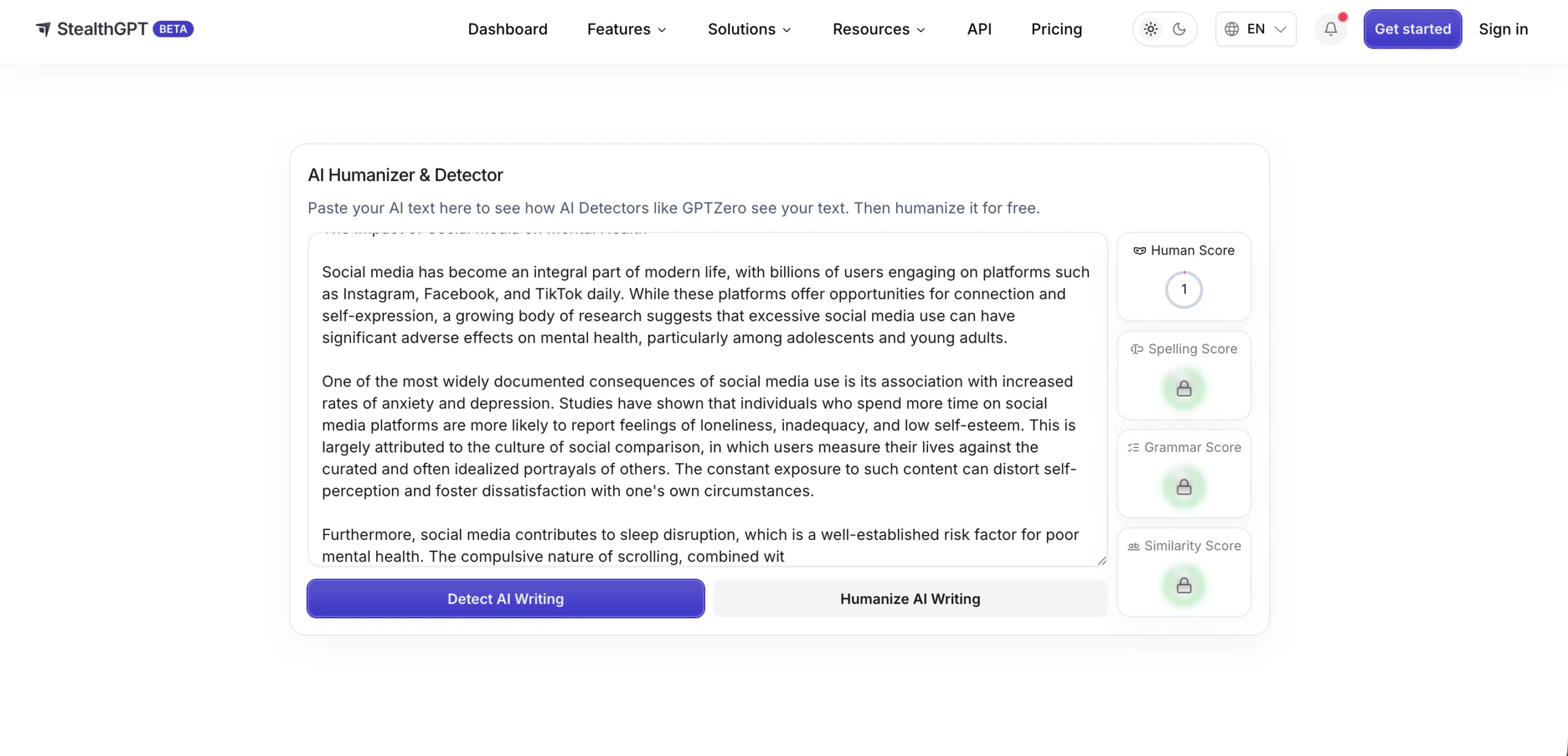
Honestly? Neither. In my testing, both tools failed to bypass AI detection entirely. StealthGPT’s own AI detector checker showed just 1% human score on my input — and the humanized version still got flagged. WriteHuman’s built-in checker claimed “100% human” but the real detector disagreed completely. Independent tests confirm: StealthGPT passes some checkers sometimes (inconsistent), while WriteHuman occasionally scores low AI percentages but fails Copyleaks and Originality.ai. If you need results that truly bypass AI detection, neither tool is reliable for that purpose.
Who Wins for Content Quality?
StealthGPT edges ahead slightly for content quality — but that’s a low bar. Its engine sometimes preserves meaning well (especially for blog posts / marketing copy), though grammar errors creep in. WriteHuman produces cleaner surface-level output with better conversational tone, but the rewrite depth is shallow. Both require editing after humanization. The content quality from neither tool is publish-ready without a human pass for voice preservation and readability score improvements.
Decision Matrix: Which Tool Is Right for Your Use Case?
Pick StealthGPT if you’re a bulk content creator who needs an all-in-one platform with Chrome extension access, SEO writing, and multiple humanization modes. Pick WriteHuman if you want a simpler, cheaper one-click humanizer for quick adjustments. Pick neither if you need guaranteed results for academic writing. That’s the honest answer — and an alternative to both might serve you better.
What StealthGPT and WriteHuman Actually Do (And How They’re Different)
Both tools aim to humanize AI text so it reads as human-written. But they approach the problem differently. StealthGPT is a full AI writing suite — part AI humanizer, part content generator. WriteHuman is more focused: paste your AI-generated content, click a button, get human-like output. The difference matters depending on what you actually need.
How StealthGPT Transforms AI Text to Evade Detectors
StealthGPT uses what they call Semantic Pattern Randomization — essentially rewriting your AI-generated content by shuffling sentence structure, swapping vocabulary, and injecting variation that (theoretically) makes text undetectable. The interface looks like ChatGPT — a sidebar with tools including AI Humanizer, Stealth Writer, Chat with PDF, AI Checker, Study Simulator, and their SEO-optimized writer. Processing took under a minute in my testing. Fast, but speed means nothing if results don’t hold up against GPTZero or Copyleaks.
StealthGPT offers multiple humanization modes — Easy, Medium, and Aggressive — each applying progressively heavier rewriting to your input. The stealth mode (Aggressive) alters sentence structure more dramatically, which can improve your stealth score but sometimes wrecks readability. You can check results with their built-in AI detector checker before copying output. For a deeper look at everything it offers, see our full StealthGPT review.

How WriteHuman Adds Emotional Tone and Human Nuance
WriteHuman takes a different approach. Instead of aggressive transformation, it focuses on tone adjustment — making AI-generated content sound more natural-sounding and human-like by adding emotional inflection, varying rhythm, and reducing robotic patterns. Their Enhanced model — covered in depth in our WriteHuman review — is the main tool, and it works as a one-click humanizer: paste text, click humanize, done. No stealth mode toggles, no complexity. The output reads cleaner than StealthGPT’s — less awkward phrasing on first pass — but the changes are shallow. It’s surface polish, not deep transformation. That’s why it still fails when you need to bypass AI detection on strict platforms.

The Core Difference — Stealth-First vs Voice-First Humanization
StealthGPT prioritizes evasion — aggressive rewrites to fool AI detectors, even if output quality suffers. WriteHuman prioritizes voice preservation — making text sound human without butchering meaning. Neither works perfectly. StealthGPT’s aggressive mode can improve your stealth score but sometimes produces fragments that need heavy editing. WriteHuman’s gentle touch preserves tone but doesn’t change enough to bypass AI detection on strict platforms like Copyleaks. In my testing, Undetectable.ai came closest — but still didn’t pass.
Real Test Results — I Ran Both Through GPTZero, Turnitin, and Originality.ai
Here’s where the marketing claims collapse. I took a 300-word essay generated by Claude about social media’s impact on mental health. Fed it through both AI humanizer tools. Then ran every output through GPTZero — the same detector both companies claim to beat. The results were brutal.
| Detector | StealthGPT Result | WriteHuman Result | Raw AI Text |
|---|---|---|---|
| GPTZero (my test) | 100% AI detected | 100% AI detected | 100% AI |
| StealthGPT’s Own Checker | 1% human score | N/A | N/A |
| WriteHuman’s Own Checker | N/A | 100% human (misleading) | N/A |
| GPTZero (independent tests) | Inconsistent — passes sometimes | 22% AI in one test | 98-100% AI |
| Turnitin (independent) | Failed in multiple reviews | 28% AI (borderline) | 95%+ AI |
| Originality.ai (independent) | Failed — flagged as AI | 42% AI | 99% AI |
| Copyleaks (independent) | Mixed results | Failed — flagged as AI | AI detected |
StealthGPT Score Breakdown
StealthGPT markets a 99% rate and claims 0% AI on GPTZero, Turnitin, and Originality.ai. These are marketing claims — not reality. In my hands-on test, GPTZero scored the humanized output at 100% AI. The stealth score on StealthGPT’s own checker was dismal (1% human). Independent reviews from WalterWrites, Phrasly, and Originality.ai’s own blog confirm the inconsistency: it passes ZeroGPT sometimes, fails Turnitin regularly, and gets caught by Originality.ai more often than not. If you’re submitting academic writing, this AI humanizer is not your answer — and even for blog posts / marketing copy, you’ll want to run the output through a separate checker like GPTZero before publishing.

WriteHuman Score Breakdown
WriteHuman’s story is equally frustrating. Their built-in detector said my output was “100% human.” I pasted the exact same text into the leading detector — 100% AI. That’s not just a miss; it’s misleading. The human score they show you doesn’t match what real detectors report. Independent tests paint a slightly better picture: 22% AI on GPTZero in one test, 28% on Turnitin (borderline pass), and 42% on Originality.ai. But Copyleaks caught it every time. The rewriting simply isn’t deep enough to bypass AI detection reliably. WriteHuman’s approach to humanize AI text works for tone — not for evasion. Check our Undetectable.ai vs WriteHuman comparison for how it stacks up against a stronger competitor.

Which Tool Passes Stricter Detectors in 2026?
Neither passes Turnitin consistently. WriteHuman gets closer (28% AI vs outright failure for StealthGPT), but “borderline” isn’t “passing.” Turnitin’s 2026 engine catches subtle AI patterns in sentence structure that most humanizers can’t fully mask. Copyleaks and Writer.com Detector are similarly tough. If you’re a student hoping to bypass AI detection on graded work — neither tool is safe. HIX Bypass, Phrasly, and Grubby AI face the same problem. It’s industry-wide.
Feature-by-Feature Comparison — What You Actually Get
StealthGPT’s Chrome Extension, API Access, and SEO Writer
StealthGPT’s biggest advantage is breadth. The Chrome extension works on any website — highlight text, right-click, humanize AI text directly. No copy-pasting between tabs. You also get Stealth Writer (a built-in AI content generator), an SEO-optimized writer for blog posts, a Study Simulator, Photo-to-Answer, and Chat with PDF. It’s an all-in-one platform that goes beyond just being an AI humanizer. File upload and 100+ language support round it out. All features — including the Chrome extension and stealth mode — are included on every paid plan, with word count limits varying by tier. For the full breakdown, see our StealthGPT review.
WriteHuman’s Tone Customization and Integrations
WriteHuman keeps it minimal. You get the web app, the Enhanced model for humanization, and a built-in AI detector. That’s essentially it — no Chrome extension, no SEO writer, no PDF tools. The tone adjustment is the selling point: it tries to make AI-generated content sound natural-sounding while preserving your original voice. For quick one-off uses, it’s faster than StealthGPT because there’s nothing to configure. But if you need to humanize AI text at scale — say hundreds of blog posts — the word count limits (600 words per request on Basic) and subscription credits cap will slow you down fast. There’s no API access, no CMS integration. Quillbot offers more flexibility for raw changes, though it doesn’t focus on helping you bypass AI detection specifically.
Features StealthGPT Has That WriteHuman Doesn’t (and Vice Versa)
StealthGPT wins on features by a mile — Chrome extension, multiple humanization modes, stealth mode, SEO writer, API access, file upload, Study Simulator. WriteHuman has none of these. But WriteHuman wins on simplicity. If you just need a one-click humanizer with decent tone adjustment, the single-screen approach is faster. The readability score of WriteHuman’s output is slightly better (fewer grammar issues) than StealthGPT’s Aggressive mode. Neither tool offers a meaningful free trial.
Pricing Comparison — StealthGPT vs WriteHuman Plans Broken Down
StealthGPT Pricing: What You Get at Each Tier (2026)
| Plan | Price | Daily Uses | Words/Use | Extras |
|---|---|---|---|---|
| Essential | ~$1.15/day | 50 | 1,000 | iOS + Chrome extension |
| Pro | ~$1.45/day | 100 | 1,500 | 3 seats |
| Business | ~$3.55/day | 500 | 2,000 | 5 seats |
| Enterprise | ~$18.55/day | Unlimited | 10,000 | 10 seats |

StealthGPT uses per-day pricing — unusual for a SaaS tool. All plans include the Chrome extension, AI detector checker, and SEO writer. Subscription credits don’t roll over. Worth noting: Trustpilot has billing complaints about auto-renewal catching users off guard.
WriteHuman Pricing: Is It Worth It?
| Plan | Monthly (Annual) | Requests/Month | Words/Request |
|---|---|---|---|
| Basic | $12 | 80 | 600 |
| Pro | $18 | 200 | 1,200 |
| Ultra | Not published | Higher | 3,000 |
WriteHuman looks cheaper, but the subscription credits are restrictive. 80 requests × 600 words = 48,000 words/month on Basic — fine for light use, limiting for serious creators. The value gets murky when you factor in editing time and inconsistent detection bypass results. You’re paying to get partway there.
Use Case Fit — Bloggers, Students, and Content Creators
StealthGPT Is Better If You’re a Developer, SEO Writer, or Bulk Content Creator
StealthGPT’s all-in-one platform approach makes it the better AI humanizer for power users. The Chrome extension means you can humanize AI text inside Google Docs, WordPress, or any web-based editor — no tab-switching. The built-in SEO-optimized writer helps generate and transform content in one workflow. Stealth Writer generates content designed from the start to be less detectable. If you’re producing 10+ blog posts per week and need a tool to bypass AI detection baked into your workflow, StealthGPT is the better fit — even with its inconsistencies. Just factor in proofreading time. The output quality for SEO content is acceptable after editing, and the multiple humanization modes let you balance between natural-sounding text and aggressive changes.
WriteHuman Is Better If You Need Quick De-Robotizing on a Budget
If your goal isn’t evasion but simply making AI-generated content sound less robotic — more human-like, more natural-sounding — WriteHuman works for that. The tone adjustment is decent for email drafts, social posts, and light blog work. It’s cheaper than StealthGPT for low-volume use, and the simpler interface means zero learning curve. The one-click humanizer workflow is genuinely fast. But don’t expect real detection bypass against any serious detector. Think of WriteHuman as a polish tool, not a detection bypass solution. For anything where getting flagged matters — academic writing, client deliverables — it’s not enough. For personal blog posts where you just want a more conversational tone and human-like feel? Fine.
When Neither Tool Is the Right Answer (Honest Talk)
For academic submissions or client work where getting flagged has real consequences — neither tool is reliable. AI detectors are improving faster than AI humanizer tools. Even Undetectable.ai, which outperformed both in my tests, still scored 94% AI. The whole category has a credibility problem. Check our best AI text humanizers roundup — but go in with realistic expectations.
Final Pick — StealthGPT or WriteHuman? Here’s the Honest Answer
Both tools failed my detection test. That’s the baseline. From there, it comes down to what you actually need — and what you’re willing to accept from an AI humanizer.
Choose StealthGPT If…
- You need a Chrome extension for in-browser humanization
- You want an all-in-one platform (AI humanizer + SEO writer + Stealth Writer + AI detector checker)
- You produce high-volume content and need daily capacity
- You want multiple humanization modes to control aggressiveness
- You’re creating blog posts / marketing copy where detection bypass results are acceptable
Choose WriteHuman If…
- You want a simple, no-frills AI humanizer with a clean interface
- Your budget is tight and you only need occasional humanization
- You care more about natural-sounding output than aggressive detection bypass
- You’re comfortable with a web-app-only tool (no Chrome extension needed)
- You just want to de-robotize short pieces — emails, social captions, quick blog posts
FAQ
More AI Humanizer Guides
Continue through the AI humanizer silo with our hands-on reviews, comparisons, and tested coupon guides.
- Best AI Text Humanizer Tools
- Undetectable AI Review
- HumanizerPro Review
- WriteHuman Review
- BypassGPT Review
- StealthGPT Review
- HumanizeAI Review
- Clever AI Humanizer Review
- Undetectable AI vs StealthGPT
- Undetectable AI vs BypassGPT
- Undetectable AI vs WriteHuman
- Undetectable AI vs HumanizerPro
- Undetectable AI vs HumanizeAI
- Undetectable AI vs Clever AI Humanizer
- StealthGPT vs BypassGPT
- Undetectable AI Coupon Code
- Undetectable AI Alternatives
Is StealthGPT better than WriteHuman for bypassing AI detection?
Neither tool reliably passes detection in 2026. In my testing, both StealthGPT and WriteHuman were flagged as 100% AI by major detectors. StealthGPT offers more aggressive humanization modes and a broader feature set, but its results are inconsistent across major academic detectors.
Does WriteHuman actually make AI text undetectable?
No. WriteHuman’s built-in checker may show a high human score, but independent detectors like Copyleaks and ZeroGPT still flag the output as AI-generated content. WriteHuman is better described as a rewriting and tone adjustment tool rather than a reliable detection bypass solution.
Can StealthGPT or WriteHuman bypass Turnitin in 2026?
Neither tool consistently passes academic detectors. Independent tests show WriteHuman scoring 28% AI (borderline) and StealthGPT failing outright. For academic submissions, relying on either AI humanizer is risky and not recommended.
Which is cheaper — StealthGPT or WriteHuman?
WriteHuman starts at $12/month (annual billing) for 80 requests. StealthGPT starts at roughly $1.15/day for 50 daily uses. For high-volume use, StealthGPT offers more words per dollar. For light, occasional use, WriteHuman’s lower cost is more economical.
Does StealthGPT have a Chrome extension?
Yes. StealthGPT’s Chrome extension works on any website, letting you work directly in Google Docs, Gmail, WordPress, or any browser-based editor. WriteHuman does not offer a Chrome extension — it’s web-app only.
Are there better alternatives to StealthGPT and WriteHuman?
Undetectable.ai performed better than both in my testing, though it still didn’t fully produce undetectable results against strict detection tools. Other options include BypassGPT, HIX Bypass, and Phrasly. Check our best AI text humanizers roundup for a full comparison of alternatives.
Do StealthGPT and WriteHuman offer free plans?
Both offer limited testing options but no meaningful free plan for production use. The free tier is too restricted for regular content creation with either AI humanizer tool.