

Zebracat’s current pricing cards show Cat Mode at $39, Super Cat at $99 and Unlimited Cat at $199 per month. Those cards also list separate generative AI credits. The word “unlimited” therefore needs context: unlimited video creation does not establish unlimited generated footage.
The official page contains a material pricing conflict. The FAQ still describes older prices and different allowances. We use the current pricing cards for the comparison below and explain which details need confirmation before you subscribe.
Zebracat plans and advertised prices
| Plan | Monthly payment | Annual displayed monthly equivalent | Video creation | Generative AI credits/month |
|---|---|---|---|---|
| Cat Mode | $39 | $23 | 15 videos/month | 350 |
| Super Cat | $99 | $59 | 40 videos/month | 1,400 |
| Unlimited Cat | $199 | $119 | Unlimited videos advertised | 3,600 |
| Enterprise | From $599; custom quote | Confirm with sales | Custom terms | Custom terms |
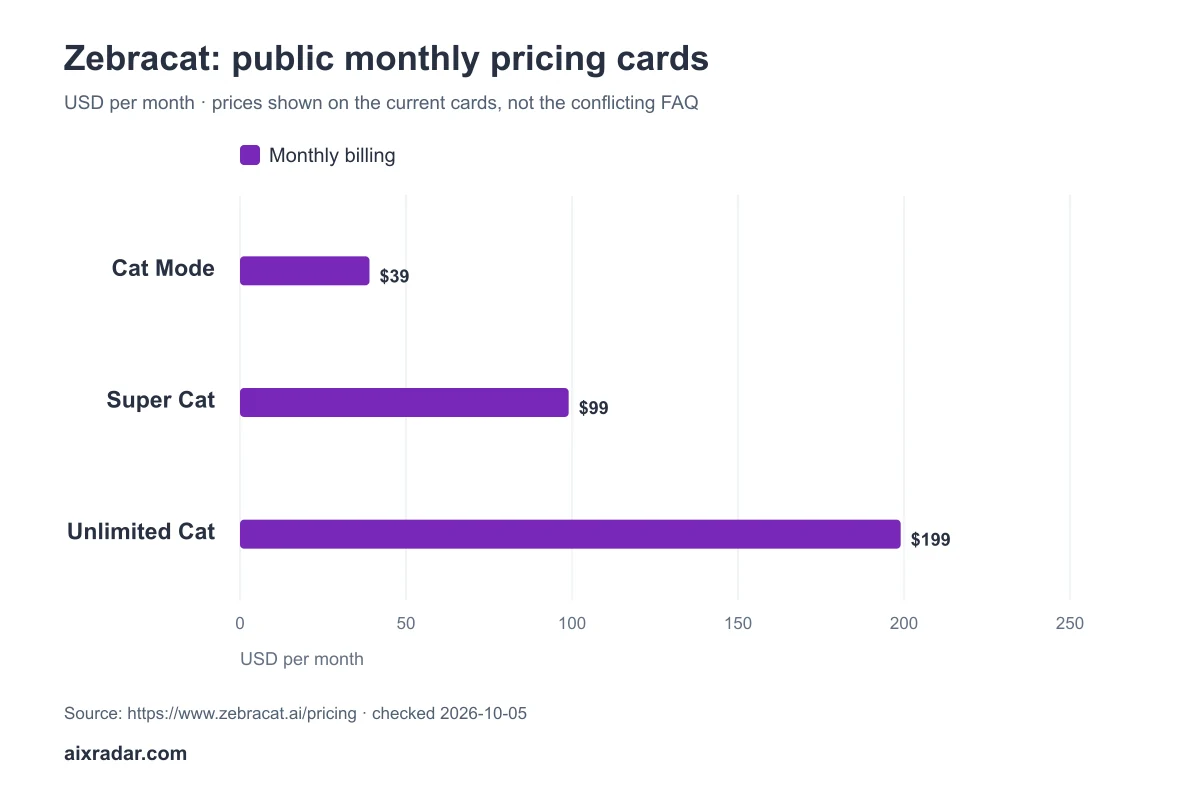
Zebracat official pricing cards · checked 5 October 2026.
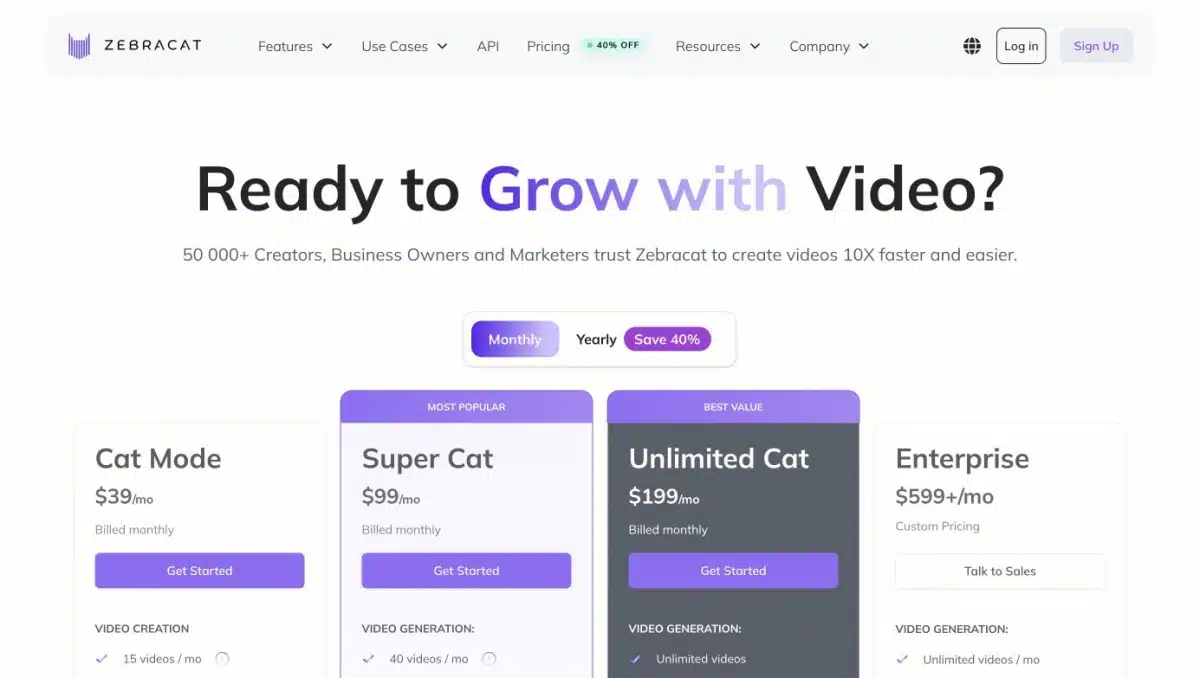
Why the FAQ gives different Zebracat prices
The FAQ describes $29 and $79 plans and a 30% annual saving, while the visible cards show $39 and $99 and advertise 40% annual savings. It also uses video-minute allowances that differ from the cards’ video counts. Elsewhere, the page’s length descriptions disagree. We have not treated these as interchangeable versions of the same limit.
Before paying, get confirmation of the maximum length for your chosen workflow, whether a free allowance still applies, and which generation actions use the listed credits. Save the plan summary attached to your order. The public page alone cannot resolve account-specific eligibility.
What our existing Zebracat tests add to plan selection
Malik’s saved notes cover 30 June–2 July 2026 on a brand-provided Super Cat account. He uploaded a four-minute video and its audio to create a custom avatar and voice clone, then generated a thirty-second avatar clip. The notes record roughly two minutes for the preview and visible teeth artifacts in the custom avatar. Those observations concern that input and older workflow, rather than every avatar or today’s processing speed.
He also used the same script with the built-in AMELIA avatar. The recorded impression was better facial detail and lip sync, but the avatar’s gestures and upbeat manner did not suit the historical lost-cities subject. For pricing, the lesson is that extra capacity cannot fix a poor creative match: inspect the avatar’s style before paying to produce a batch.
A Blog to Video attempt produced a script Malik found too generic. He replaced it with a separately prepared script before generating another video. Budget the script preparation and revision time as part of the workflow. A plan offering enough projects does not mean those projects will be ready to publish without editorial work.
The full Zebracat review contains the original screenshots and observations. This pricing article reuses the relevant experience without turning it into a fresh comparison or a guarantee about current features.
Video counts and credits answer different questions
A video count tells you how many projects the plan advertises. A generative-credit balance tells you how much newly generated material you can request. A project built largely from uploaded or stock assets may have a very different credit budget from a project full of regenerated AI scenes.
Zebracat also has a credit help article that describes component-based charges. Those older component figures should not be combined with the pricing cards’ generative-credit allowance to claim a current cost per video. The units need reconciliation first.
A workload example without a made-up generation cost
If you need twelve finished videos every month, Cat Mode’s advertised fifteen-video allowance leaves three projects of headroom. A schedule of twenty videos exceeds that count and makes Super Cat the next tier to compare. This simple comparison says nothing about whether the generative credits can support the scenes you want.
For twelve finished videos, allocating the $39 monthly subscription gives $3.25 per finished video before taxes and editing time. If only eight are usable, that allocation rises to $4.88. Neither number is a tested generation price. The practical value depends on how many completed outputs you can use, not how many projects you can start.
Build a separate scene estimate before committing: expected generated shots, revisions per shot and the credit quote for the selected model. Until you can see that quote, leave the credit-cost cell blank rather than substitute an older tutorial’s figure.
Why the old lip-sync record cannot price today’s videos
The older notes record 22 lip-sync credits for one thirty-second preview. That is about 0.73 recorded credits per second for that one action, not proof of a fixed one-credit-per-second tariff. It is also not enough evidence to convert the current generative-credit balance into a guaranteed number of avatar minutes.
Keep three items on a production worksheet: the project count, the quoted charge for each generated component, and whether the result was usable. Note the date and model beside the quote. When an avatar or scene needs another attempt, add the new quote rather than assuming the original project allowance covers unlimited regeneration.
For twelve planned videos, three spare projects under Cat Mode’s fifteen-video allowance provide only a small buffer if your workflow consumes a new project for an alternative version. Confirm what counts as a project in the account before interpreting that buffer. A stock-led video, a custom-avatar video and a generative-scene video should each have a separate budget row.
Annual savings need a complete production plan
The displayed annual monthly equivalents imply $276 for Cat Mode, $708 for Super Cat and $1,428 for Unlimited Cat over twelve months, before tax or a separately accepted code. These are calculations from the current cards. Compare them with the number of months you expect to use the tool, not just with twelve months of monthly billing by default.
Before committing annually, settle the intended video length, avatar requirement and recurring schedule. The unresolved FAQ differences matter most when one of those limits is central to your project. A written answer from support or an account plan summary is stronger evidence than selecting the most generous wording from conflicting sections.
Which Zebracat plan makes sense?
Compare Cat Mode for a small recurring schedule, Super Cat for a larger schedule, and Unlimited Cat when project count would otherwise constrain you. In each case, check generative capacity separately. Enterprise pricing deserves a written scope that states users, support and usage terms.
See our Zebracat review for product coverage and the existing MALIK offer page for partner-code instructions. This pricing check does not confirm that a code stacks with annual pricing. Other video tools are grouped in our AI video tools hub.
Does Zebracat have a free plan?
The FAQ mentions a five-video free allowance, but its surrounding plan information conflicts with the current cards. Treat that as an unresolved public claim until the signup or account summary confirms the present allowance.
Evidence: Pricing cards and saved FAQ evidence are dated 5 October 2026; hands-on observations come from Malik Hasnain’s earlier Super Cat evaluation. Component costs and coupon eligibility were not retested in checkout. Our testing policy explains the limits of reused test notes.
Check Zebracat plans. Confirm the billing period, final amount and renewal terms before paying.