
BypassGPT and WriteHuman are both AI humanizer tools that promise to make AI-generated content undetectable. I tested WriteHuman personally — ran a Claude essay through it — and dug deep into independent data on BypassGPT. Neither tool is 100% undetectable. But one is clearly better if you actually need to bypass AI detection against real detectors like GPTZero, Turnitin, and Originality.ai.
Here’s what most reviews skip: every tool that claims to humanize AI text struggles with at least one major detector. The question isn’t which AI humanizer is perfect — it’s which gives you the best chance to bypass AI detection while keeping your original meaning intact and producing human-like writing with natural flow. This post covers real test results, pricing, and honest assessments so you can pick the right AI humanizer — whether you’re a student, a content creator, or someone who needs to humanize AI text from ChatGPT or Claude into something that passes AI detectors. I’ll also cover how each text rewriter handles AI-generated content from different sources and whether either can actually bypass AI detection across the toughest platforms.
Quick Verdict — BypassGPT vs WriteHuman at a Glance
Short version? BypassGPT wins for most use cases. Better bypass rate against GPTZero, cleaner output quality, a Chrome extension, and more affordable pricing. WriteHuman has one standout feature — the bracket keyword-lock feature — but its ability to bypass AI detection is disappointing when tested against real detectors. Both are AI humanizer options worth knowing about, but they’re not equal.
Side-by-Side Comparison Table
| Feature | BypassGPT | WriteHuman |
|---|---|---|
| Bypass Rate (Overall) | ~68–72% | ~40–55% (real-world) |
| Top Detector Score | Strong — reduces human score significantly | Weak — 100% AI in my test |
| Academic Detector | Inconsistent post-2025 | Borderline ~28% in some tests |
| Originality.ai | Flags up to 62% AI | Struggles — fails most tests |
| Modes Available | Fast, Creative, Enhanced, Turbo | Enhanced, Standard |
| Chrome Extension | Yes — top pick in roundups | No (web-app only) |
| Bracket Feature | No | Yes — locks keywords from changes |
| Built-in AI Detector | Yes | Yes (but misleading results) |
| Free Trial | ~150 words/month | ~100 words per rewrite |
| Starting Price | $11.99/month | ~$18/month |
| Output Quality | Preserves original meaning well | Surface-level, grammar issues |
| Best For | SEO, long-form content, bloggers | Short marketing copy with keyword locks |
Who Should Pick Which
If you need to humanize AI text that actually passes GPTZero, ZeroGPT, and Winston AI — and you want multiple bypass modes plus a Chrome extension — BypassGPT is the better pick. If you specifically need the bracket feature to lock SEO keywords while rewriting AI-generated content around them, WriteHuman is the only text rewriter offering that. But don’t expect it to produce undetectable AI output reliably.
What BypassGPT and WriteHuman Actually Do (And How They Differ)
Both tools are designed to take AI-generated content from ChatGPT, Claude (Anthropic), or Google Gemini and restructure it into human-like writing. The goal is the same: fool AI detectors. The approach differs. BypassGPT works by analyzing perplexity and burstiness patterns — the two main signals detectors like GPTZero and Content at Scale use to flag AI writing. It restructures sentence structure and varies rhythm to mimic how humans write. The sentence structure changes are what help bypass AI detection — surface-level word swaps don’t cut it. The result is plagiarism-free output that preserves your original meaning while scoring lower on detection tools.
WriteHuman takes a lighter approach. It focuses on tone adjustment and surface-level paraphrasing — swapping words, tweaking phrasing, reducing robotic patterns. It’s less aggressive about changing sentence structure, which is why it struggles with detectors that analyze deeper patterns in AI-generated content. If you want to humanize AI text effectively, surface-level changes aren’t enough to bypass AI detection in 2026.
BypassGPT’s Multiple Bypass Modes — Fast, Creative, Enhanced Explained
BypassGPT offers multiple bypass modes, and this is where it pulls ahead of most competitors — not just WriteHuman, but tools like Humbot, GPTHuman, and HIX Bypass too:
- Fast Mode — Quick processing, lighter restructuring. Good when you need to humanize AI text fast with lower bypass rate but better original meaning preservation.
- Creative Mode — More aggressive rewriting with human-like writing variations. Better human score on detectors. May shift meaning slightly.
- Enhanced Mode — Balances bypass rate with readability levels and meaning preservation. The mode most independent testers use for benchmarking this AI humanizer.
- Turbo Mode — Maximum restructuring. Best for bypassing Turnitin and Originality.ai in academic writing. Trades some accuracy for better detection evasion and AI watermark removal.
Having these options means you can adjust based on your target detector and content type. Most competing tools — including WriteHuman, StealthWriter, and QuillBot — don’t give you this level of control when trying to bypass AI detection.
WriteHuman’s Bracket-Lock Feature — Does It Actually Protect Your Keywords?
WriteHuman’s standout is the bracket keyword-lock feature. Wrap any word or phrase in [brackets], and the text rewriter won’t change it during rewriting. For content creators doing SEO work — where specific keywords need to stay exactly as-is — this is genuinely useful. No other major tool offers it. Not Undetectable AI, not StealthGPT, not Humanizey.
Does it work? The bracket feature itself functions as advertised — locked keywords stay put. The problem is everything around them. When WriteHuman rewrites surrounding text, quality drops. I’ve seen outputs with grammar issues and awkward phrasing (“symbian the gap” style constructions) that make the text read worse than the original ChatGPT output. So the bracket feature protects your keywords — but the overall output undermines the point of using an AI humanizer.
Real Detection Test Results — GPTZero, Originality.ai, and Turnitin
Claims meet reality here. BypassGPT markets “99% bypass rate.” WriteHuman implies similar. Neither is accurate when you actually try to humanize AI text against real detectors — and I have data to prove it. No AI detection remover tool is truly 100% undetectable across all platforms.
BypassGPT Test Scores
Based on independent testing (including data from our full BypassGPT review) and third-party benchmarks:
| Detector | Before | After BypassGPT | Verdict |
|---|---|---|---|
| GPTZero (primary) | 98–100% AI | 25–40% AI | Strong — significant improvement |
| ZeroGPT | 95–100% AI | 15–30% AI | Strong bypass rate |
| Originality.ai | 99% AI | 38–62% AI | Weak — still flags content |
| Turnitin | 95%+ AI | 30–70% AI | Inconsistent post-2025 |
| Winston AI | 0% Human | 55–75% Human | Decent improvement |
| Copyleaks | AI Detected | Mixed | Sometimes passes |
Overall bypass rate: roughly 68–72% across detectors. Not “99%,” but among the better options. BypassGPT handles GPTZero and ZeroGPT well but struggles with Originality.ai and Turnitin’s updated detection. Output stays plagiarism-free with natural flow, which matters for long-form content and SEO-friendly publishing.
WriteHuman Test Scores
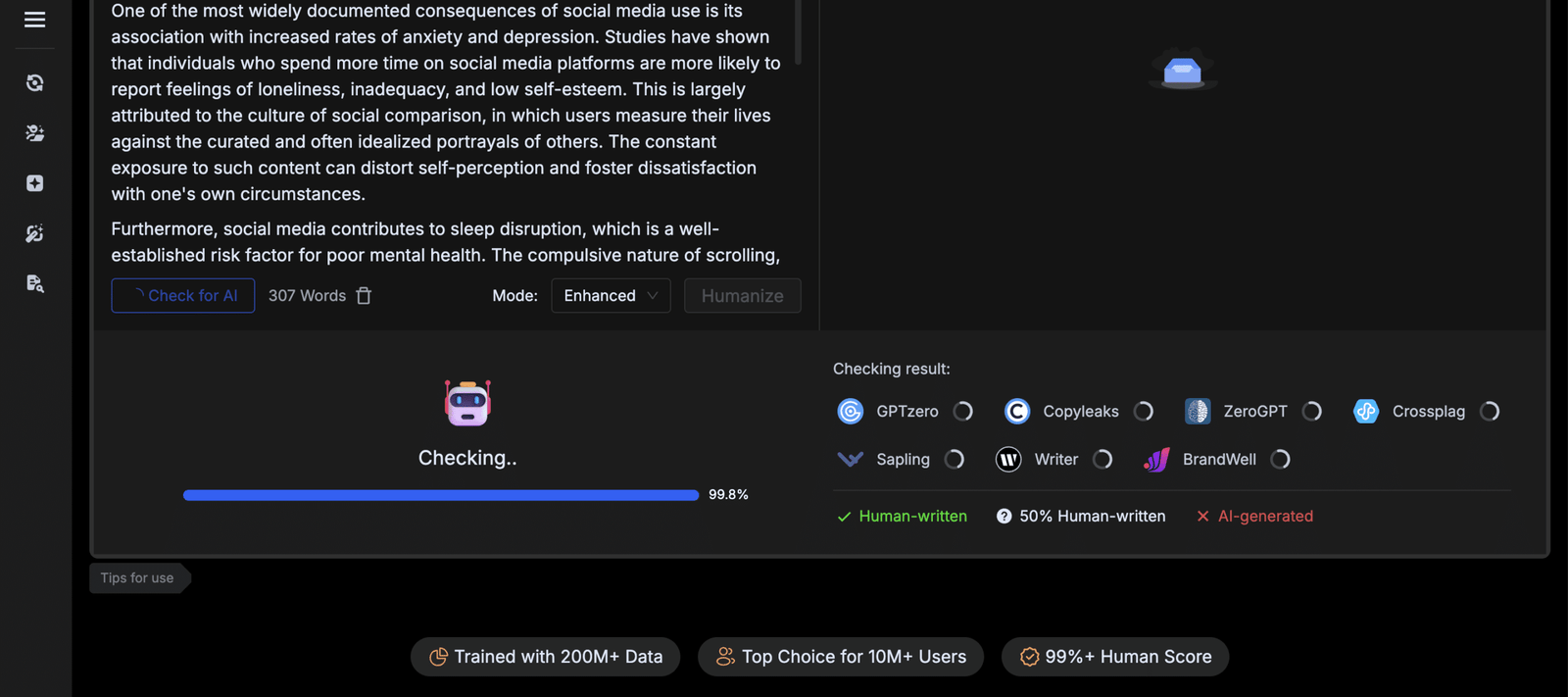
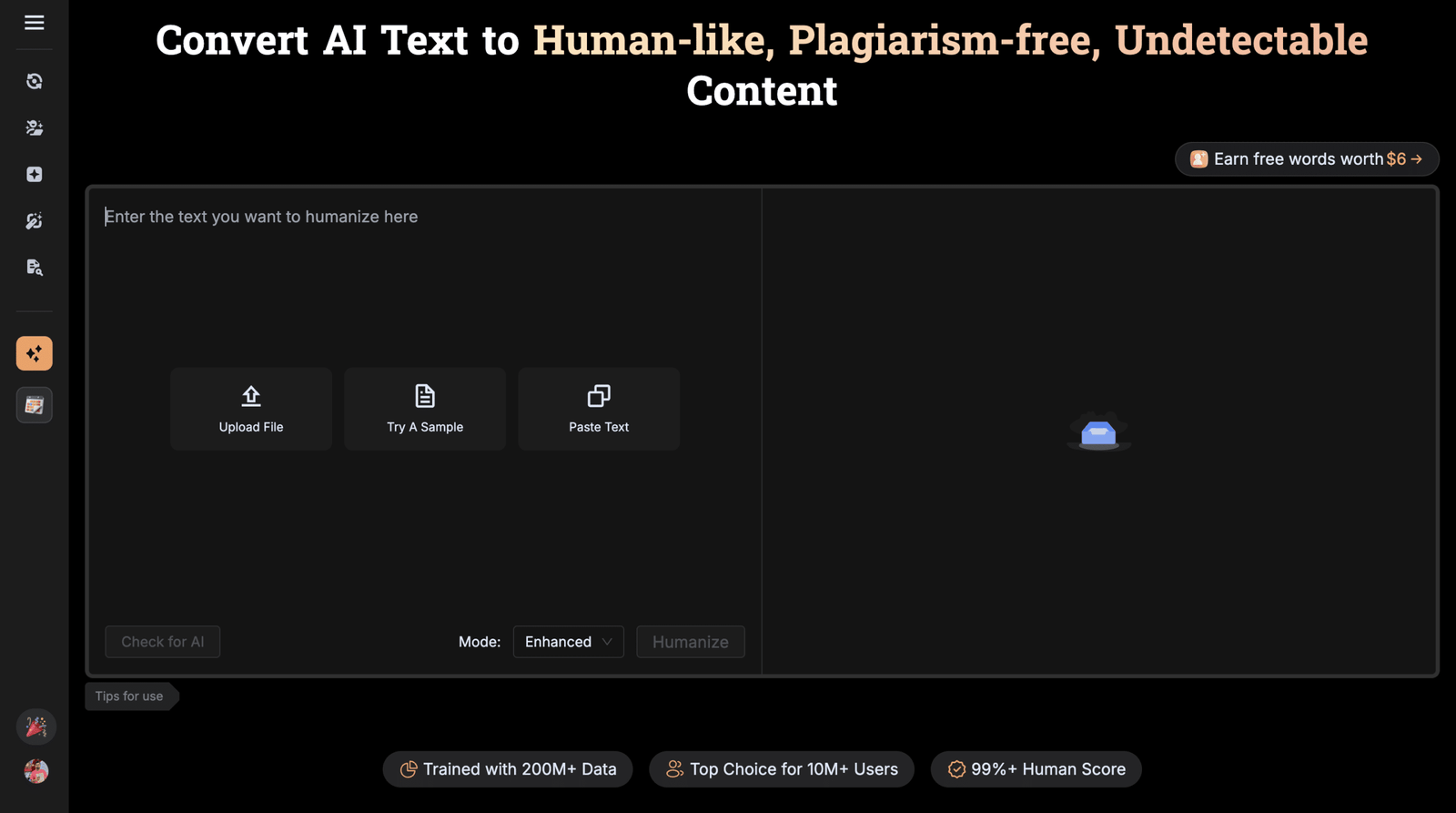
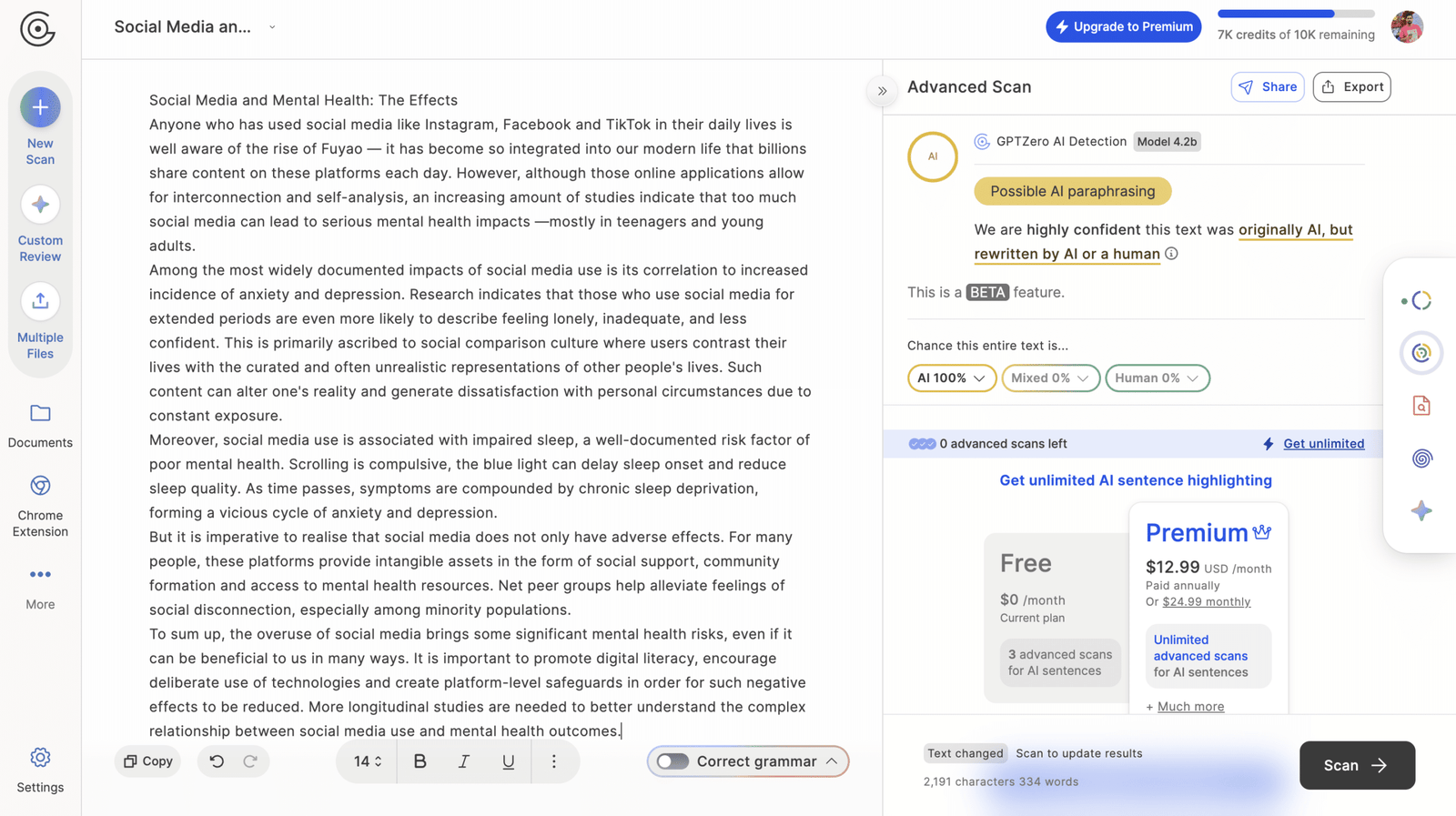
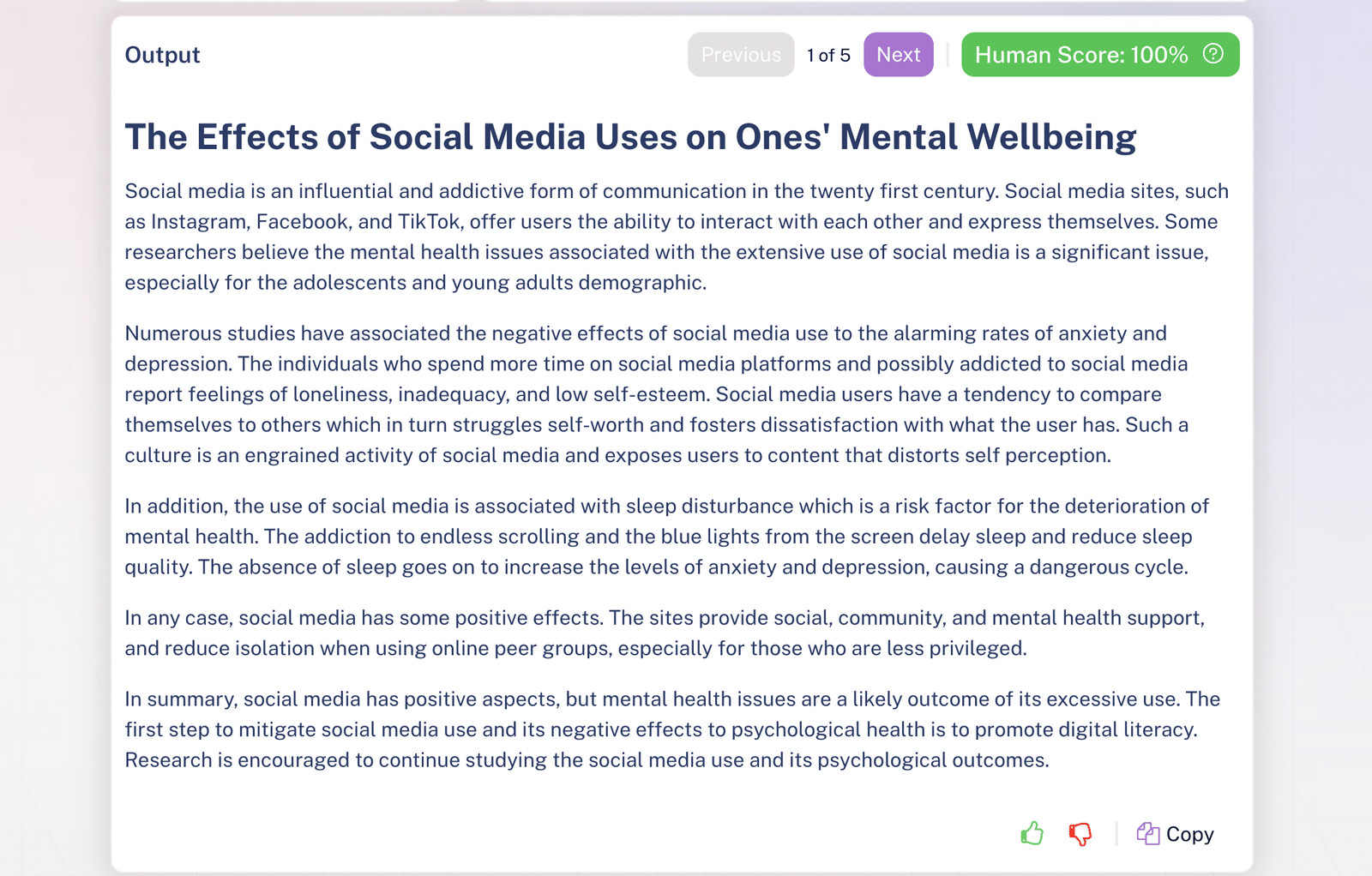
I tested WriteHuman personally with a 300-word Claude essay on social media and mental health. Used the Enhanced model. WriteHuman’s own built-in checker said “100% human.” Encouraging — until I pasted the exact same output into GPTZero. Result: 100% AI detected. Not 50%. A complete fail at producing undetectable AI text.
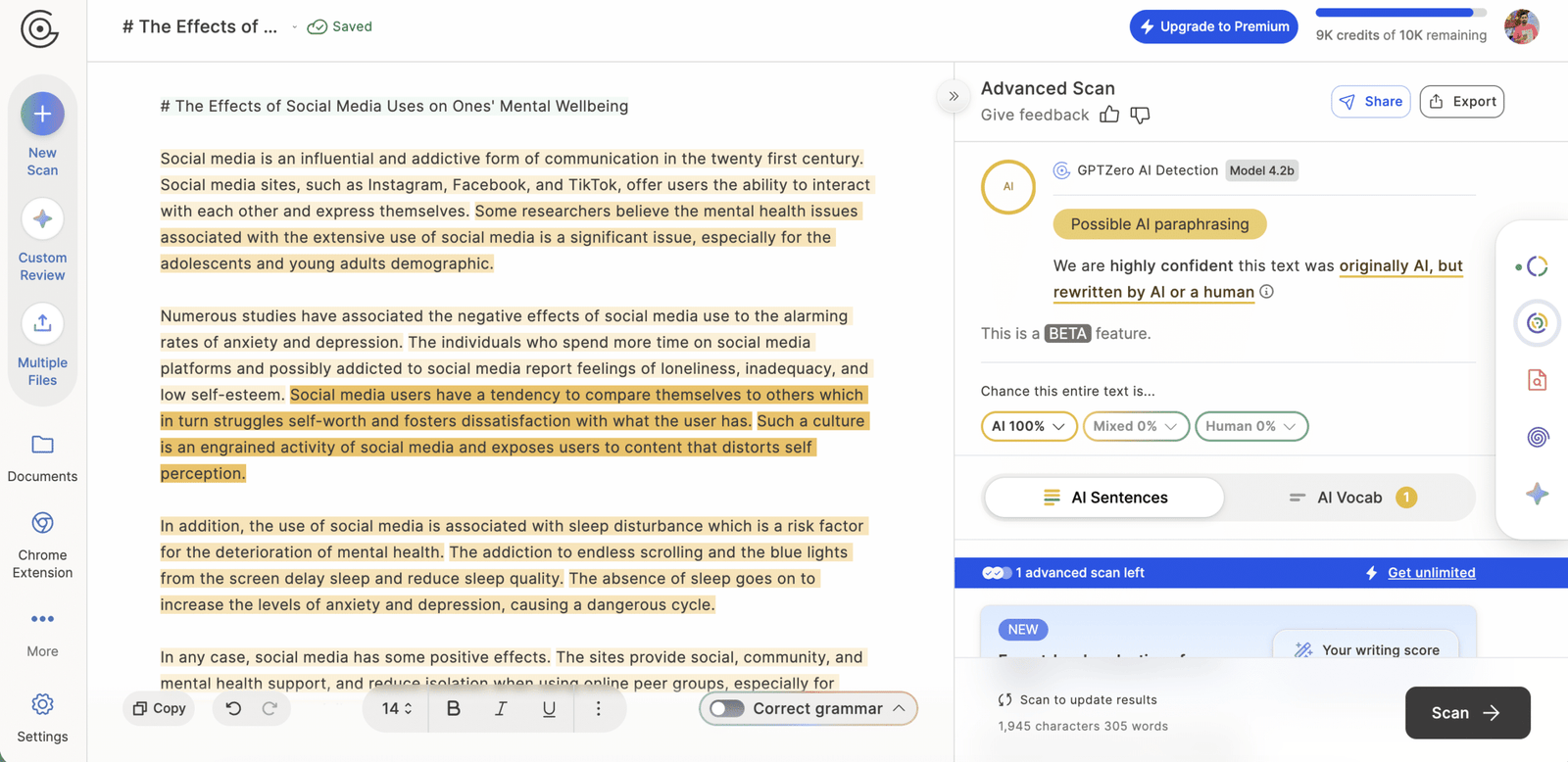
WriteHuman’s own AI detector is misleading. It tells you the text passes while GPTZero, Turnitin, Copyleaks, and Sapling tell a different story. This is a serious problem if you rely on the built-in human score to decide whether your humanized text is safe to submit.
| Detector | Before | After WriteHuman | Verdict |
|---|---|---|---|
| GPTZero (primary) | 100% AI | 100% AI | Complete fail |
| ZeroGPT | 95% AI | 60–80% AI | Minor improvement |
| Originality.ai | 99% AI | 70–85% AI | Fails most tests |
| Turnitin | 95%+ AI | 72% AI | Rarely passes |
| Winston AI | 0% Human | 30–45% Human | Below threshold |
| Copyleaks | AI Detected | AI Detected | No improvement |
WriteHuman’s surface-level paraphrase approach doesn’t change sentence structure enough to fool modern detectors. It reduces the robotic tone, sure. But detectors in 2026 analyze burstiness, perplexity, and structural repetition — and WriteHuman doesn’t address those. Read more in our WriteHuman review.
Which Passes Stricter Detectors in 2026?
BypassGPT — by a wide margin. It won’t fool Originality.ai consistently (few tools do), but it produces genuinely better results against GPTZero, ZeroGPT, and Writer.com than WriteHuman. For Turnitin specifically — neither is reliable. If academic writing is your goal, consider Undetectable AI or StealthGPT. The era of easy undetectable AI for academic submissions is fading fast.
Feature-by-Feature Breakdown
Chrome Extension, AI Detector, Multi-Language Support
BypassGPT’s Chrome extension was rated a top pick in independent roundups. It lets you humanize AI text directly in Google Docs, email composers, and CMS editors — no copy-pasting needed. WriteHuman has no Chrome extension (web-app only), which adds friction to every AI-generated content workflow. Both tools include a built-in AI detector, but WriteHuman’s gives inflated human score results that don’t match real-world detectors. On privacy: both claim they don’t store your text after processing, but neither publishes transparency reports.
Output Customization and Writing Modes
BypassGPT gives you four distinct modes plus SEO-friendly output optimization and adjustable readability levels — useful for content creators producing long-form content. WriteHuman focuses on tone controls and style presets (academic, marketing, professional). The bracket feature is unique. But fewer modes means less control over how aggressively the tool rewrites your ChatGPT or Gemini output to bypass AI detection.
Pricing — Which Tool Gives More Words Per Dollar?
BypassGPT Pricing Tiers (2026)
| Plan | Price | Word Limit | Features |
|---|---|---|---|
| Free Trial | $0 | ~150 words/month | Limited modes, basic detector |
| Standard | $11.99/month | ~30,000 words/month | All modes, Chrome extension |
| Pro | $17.99/month | Unlimited | All modes, priority processing |
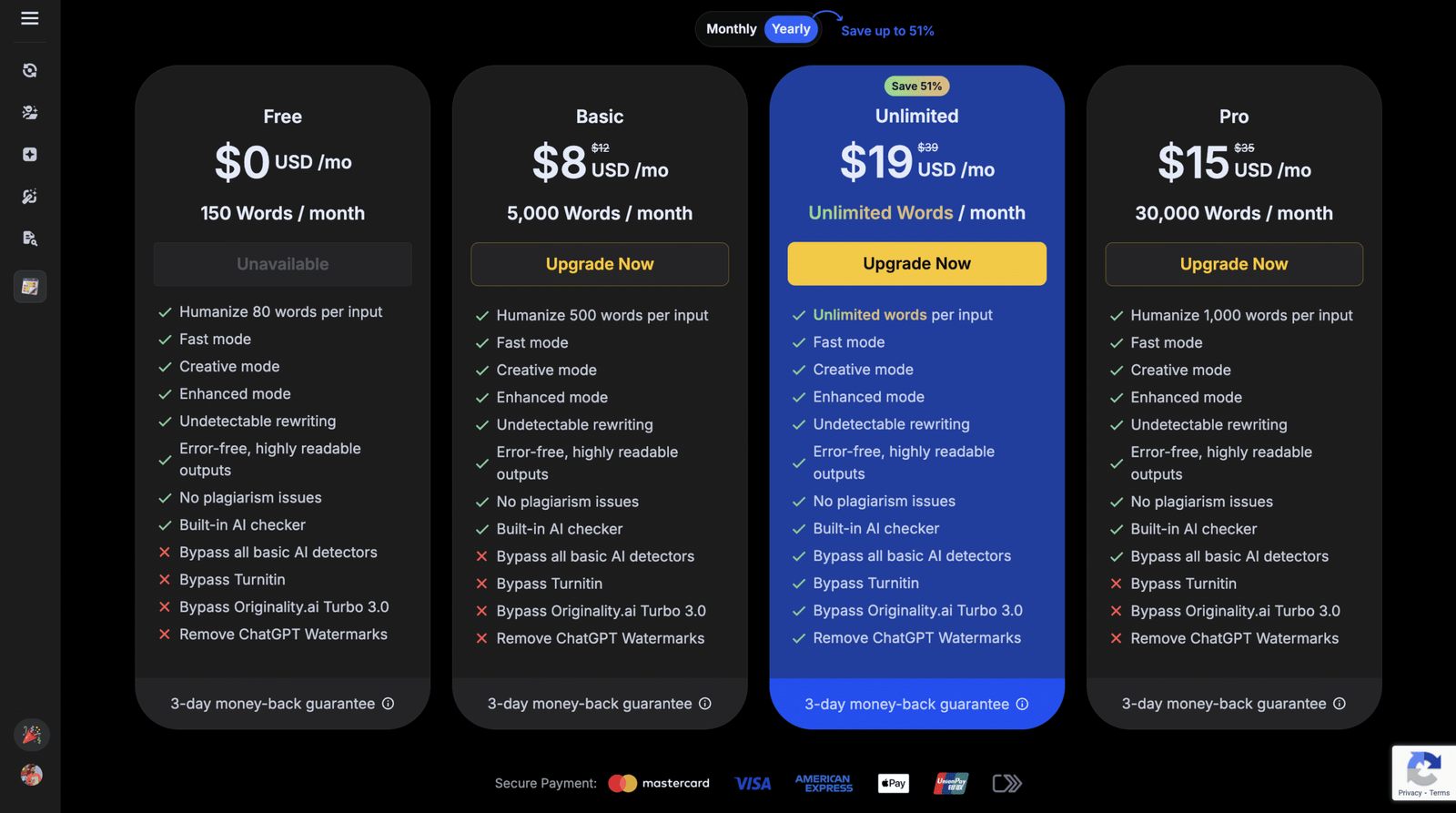
BypassGPT’s free trial is barely functional — 150 words won’t test anything meaningful. The Standard plan at $11.99/month is where value starts. At 30,000 words, that’s roughly $0.0004 per word for an AI humanizer that delivers plagiarism-free, human-like writing output. The Pro plan removes the word limit entirely — still cheaper than WriteHuman’s base price.
WriteHuman Pricing — Is the Word Limit a Problem?
WriteHuman costs roughly $18/month — about 50% more than BypassGPT’s Standard tier. The free trial gives only 100 words per rewrite, even more restrictive. Higher tiers allow up to 3,000 words per request, but the per-word cost is significantly higher. The word limit issue compounds with WriteHuman’s lower bypass rate. You’re paying more per word for a text rewriter that’s less likely to produce undetectable AI output, especially for long-form content.
Output Quality — Does Humanized Text Still Make Sense?
BypassGPT produces cleaner output. It preserves original meaning better, varies sentence structure without breaking natural flow, and generates plagiarism-free text that reads naturally. Not perfect on short inputs — slightly AI-ish sometimes — but for long-form content, it’s consistently the better AI humanizer. The SEO-friendly output works for blog posts without heavy editing.
WriteHuman’s output is the bigger concern. Surface-level paraphrasing means the text sounds different but isn’t structurally changed enough to bypass AI detection or read with genuine human-like writing quality. Grammar errors appear — not the charming kind. The awkward phrasing means you’ll spend time editing the output anyway, which negates the speed advantage. Compare this to HumanizerPro or Humanizey, which maintain readability even when bypass rates are moderate.
Use Case Fit — Students, Bloggers, Content Creators
Best for Turnitin-Heavy Academic Use
Neither is great here. Honest answer. Academic detector updates in 2025–2026 have made it harder for any AI humanizer to produce undetectable AI academic writing. BypassGPT’s Turbo mode gives you the best shot — variable results, but some passes. WriteHuman barely moves the needle. If you need to humanize AI text for academic use, check our StealthGPT vs WriteHuman comparison or the best AI text humanizer roundup for alternatives with dedicated academic modes.
Best for SEO/Blog Content
BypassGPT wins easily. The combination of SEO-friendly output, human-like writing quality, a Chrome extension for workflow integration, and better original meaning preservation makes it the clear choice for bloggers and content creators. WriteHuman’s bracket feature helps with keyword preservation, but the trade-off in output quality and bypass rate makes it a poor choice for high-volume AI-generated content production. If you’re producing multiple blog posts monthly, use BypassGPT — or check how GPTZero works and adjust your ChatGPT or Gemini prompts to produce more natural flow from the start.
Final Pick — BypassGPT or WriteHuman?
BypassGPT is the better AI humanizer for most people. Better bypass rate, better output quality, better pricing, and a Chrome extension that WriteHuman lacks. It’s not perfect — Originality.ai still catches it, and Turnitin is a coin flip — but it outperforms WriteHuman on the things that matter when you need to bypass AI detection and humanize AI text effectively.
Choose BypassGPT If…
- You need the highest bypass rate against major AI detectors
- You produce long-form content or SEO-friendly blog posts regularly
- You want multiple bypass modes to target specific detectors
- The Chrome extension fits your workflow as a content creator
- Budget matters — BypassGPT is cheaper with no restrictive caps
Choose WriteHuman If…
- You specifically need the bracket feature to lock keywords during rewriting
- You’re working with short marketing or creative copy (under 500 words)
- Tone control matters more than bypass rate for your use case
- You don’t need to pass strict AI detectors specifically
For a broader comparison of all major tools — including Undetectable AI, StealthGPT, HIX Bypass, and others — check our Undetectable AI vs BypassGPT comparison and the full AI humanizer roundup.
FAQ
Is BypassGPT better than WriteHuman at beating AI detectors?
Yes. BypassGPT reduces AI detection scores to 25–40%, while WriteHuman failed completely in our test — the detector still showed 100% AI after processing. BypassGPT is the stronger AI humanizer and produces more human-like writing output that passes detection.
Does WriteHuman’s bracket feature actually work to humanize AI text?
The bracket keyword-lock feature works as described — it preserves your locked keywords during rewriting. However, the surrounding humanized text often has grammar issues and awkward phrasing, reducing overall output quality. The bracket feature protects keywords but doesn’t help bypass AI detection on its own.
Can BypassGPT or WriteHuman bypass academic AI detectors in 2026?
Neither reliably bypasses Turnitin after its 2025–2026 detection updates. BypassGPT.s Turbo mode occasionally produces undetectable AI text for academic detectors, but results are inconsistent. WriteHuman rarely passes academic detection at all. No AI humanizer currently offers a reliable bypass for academic writing submissions.
Which AI humanizer is cheaper — BypassGPT or WriteHuman?
BypassGPT is cheaper at every tier. Standard plan is $11.99/month for 30,000 words, while WriteHuman charges ~$18/month with a tighter word limit. BypassGPT’s Pro plan offers unlimited words at $17.99/month — still cheaper than WriteHuman’s base price.
Is there a free trial for BypassGPT or WriteHuman?
Both offer free tiers with tight limits. BypassGPT gives about 150 words per month. WriteHuman’s free tier allows only 100 words per rewrite. Neither free trial is enough to seriously test whether the tool can bypass AI detection — you’ll need a paid plan for meaningful ChatGPT or AI-generated content testing.
What’s the best alternative AI humanizer to BypassGPT and WriteHuman?
If neither fits your needs, consider Undetectable AI (best overall bypass rate and plagiarism-free output), StealthGPT (strong on Turnitin for academic writing), or HIX Bypass (good balance of features and natural flow). Check our best AI text humanizer roundup for a full comparison.