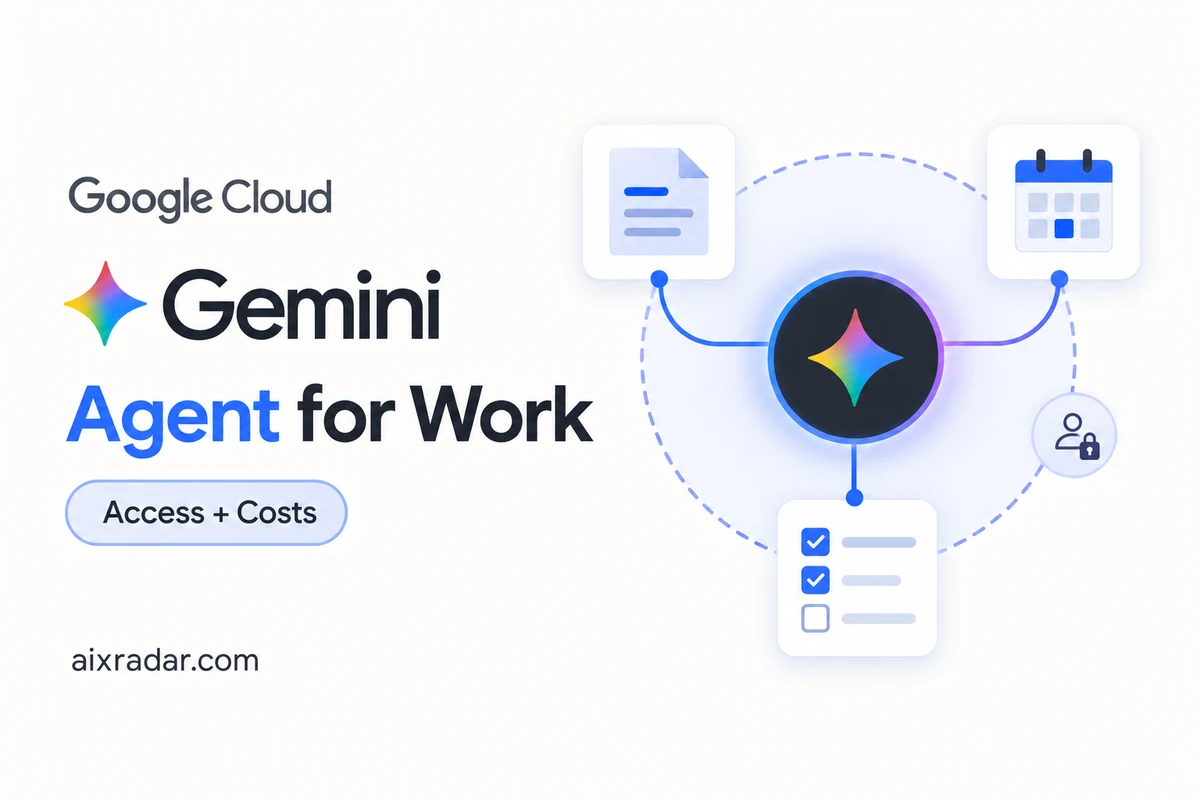

Google’s Gemini agent for work was announced at Gemini at Work on 8 October 2026. Google describes an assistant that can carry a task across business applications, rather than merely answer a question in a chat window. For small teams, the useful question is whether that connected workflow is available in their account, affordable and controllable. Google’s official announcement establishes the launch; it does not establish universal access.
Reporting cutoff: 9 October 2026, 17:58 Pakistan time. This is source-based reporting and practical analysis; AIX Radar has not tested the new agent hands-on.
What Google announced: an agent that carries work forward
The Google Cloud keynote describes persistent cloud execution, task-specific subagents and a separate choice of underlying model, including Gemini and Claude. It also describes coworker agents with their own identities. These are Google’s descriptions of the system, not independently measured reliability results.
Think of the difference this way: a chatbot might explain how to prepare a project update; a connected agent could help gather the material and prepare the deliverable. The second workflow requires access to files, applications and sometimes actions. Better writing alone does not prove it can complete that workflow accurately.
Our interpretation is that continuity matters more here than another leaderboard score. Work spread across several applications creates repeated handoffs. An agent can be useful if it reduces those handoffs while leaving the team able to understand, correct and stop the work. That last condition should be part of the evaluation from the start.
Who gets access, and what remains unconfirmed?
Google’s keynote identifies Financial Services and Legal specializations as previews, with Government, Healthcare and Retail coming later. It describes agent identities, permissions, audit trails and sandbox boundaries. It does not give a complete public entitlement matrix for every announced capability. We could not verify a universal general-availability date, country list or fixed price for the new agent from the official sources checked.
The existing Gemini Enterprise FAQ offers 30-day trials of the Business and Standard/Plus editions. It also distinguishes the licensed Enterprise app from the separately purchased, consumption-billed Agent Platform. Those are established entry routes, not proof that a trial includes every feature shown in this keynote.
| What you have | What it establishes | What to confirm next |
|---|---|---|
| Consumer Gemini account | A personal assistant account | Whether the work agent is offered through that account at all |
| Existing Enterprise app license or trial | An enterprise product entry route | Your edition’s specific new-agent entitlement |
| Google Cloud project | A place to configure cloud services and billing | Provisioning, permissions and charges for the intended workflow |
Do not buy an upgrade on the assumption that a similar product name guarantees access. Ask for the exact feature, edition, region and rollout status. Save that answer alongside your pilot plan so an availability issue is not mistaken for a poor model result.
How to think about cost without inventing a price
Google’s earlier billing announcement, dated 26 August, explains per-user subscriptions, consumption options and spending controls. It marks some options as limited to selected customers or forthcoming. Those details provide context; they are not a newly published price list for the October agent.
A useful budget separates the license from the work performed. Record which model handles each task, whether retries consume additional resources, and whether execution adds runtime charges. A low price per token can still produce an expensive workflow if the agent keeps researching, repeats failed steps or needs extensive manual correction.
Google’s Cloud Billing documentation explains how to distinguish seat charges from overage SKUs and group relevant product costs. For a pilot, keep a separate project or identifiable cost grouping, and compare the completed output with its bill. A spending cap limits expenditure; it does not establish that the work is useful.
Our suggested measure is cost per accepted deliverable. Include the reviewer’s correction time. If an inexpensive draft repeatedly omits important material, its apparent savings disappear once someone reconstructs the work.
A practical pilot for creators and small businesses
The following is a proposed evaluation sequence, not a record of testing we performed. Start with one recurring task whose correct output you can recognize. A weekly content brief is easier to evaluate than an open-ended instruction to manage marketing.
- Define the output. Specify the approved sources, required sections, deadline and destination. Make the first deliverable a draft that a person reviews.
- Limit the inputs. Use a small, approved project folder. Keep unrelated client material out of the pilot.
- State action boundaries. Distinguish researching and drafting from sending messages, publishing or changing records.
- Evaluate the result. Check citations, missing requirements and unsupported assertions. Record corrections rather than relying on how polished the first answer looks.
- Review the full workflow. Examine cost, elapsed time, interruptions and the point at which a human had to intervene.
For example, a creator could ask for a launch brief assembled from approved notes, with unanswered questions listed separately. Success would mean a usable draft, accurate references and no invented offer. The comparison should be with the creator’s current process using the same material.
A small business could instead pilot an internal status report. Define how conflicting updates are handled and require unresolved items to remain visible. A confident summary that hides a disagreement is worse than a report that explains it.
For another recent assistant interface change, see our GPT-6 and Intelligent UI coverage. That article concerns how answers are presented; it should not be treated as a hands-on comparison of these enterprise workflows.
Questions to resolve before expanding the pilot
Request concrete answers about who can grant access, how to revoke it, what appears in the activity history and what happens when an integration fails. Ask how the team handles a partially completed task: a draft may be recoverable, while an external action may need a separate correction.
Also decide who owns instructions and memory when someone leaves a team. A useful business workflow needs an accountable maintainer, not just an impressive demonstration. These are evaluation questions, not claims that we found defects in Google’s product.
If your main need is searching information locally, our EmbeddingGemma 2 explainer covers a different architecture and purpose. Do not assume that persistent cloud execution provides the same data boundary as a local application.
Frequently asked questions
Is this a new Gemini model?
Google describes the agent and the model underneath it as separate choices. Evaluate the connected workflow as well as the model’s individual answers.
Can a free trial prove that I have access?
Only to the capabilities actually enabled for that trial. Verify the announced feature explicitly before treating it as included.
Can we quote a single confirmed price?
We could not confirm a fixed universal price for the new work agent from the sources checked. Existing Enterprise billing is useful context but does not resolve every new entitlement.
What should an everyday user do now?
If your current assistant already handles your task, keep using it while checking the new agent’s eligibility. If connected work is your bottleneck, prepare a small pilot with a clear deliverable and review step. The announcement matters most when those handoffs can be reduced without losing accountability.